
















01
Flexibility and change
Innovation · Identity




Learn about our achievements and international accreditations.
Consult our resolutions and the legal regulations governing the university.
Explore all our academic offerings available at different locations throughout the country.
Discover the research lines and active projects of our departments.
Learn about our commitment to sustainable development and internationalization.
Check our position in the best university rankings in the world.
Access services that support your academic and personal development.
Access scholarship programs and financial aid for your fourth level training.
Learn about the values and the integral formation of our cadets and aspirants.
Complement your professional training with our foreign language program.

Meet the research groups that lead the generation of knowledge at ESPE.
Access our scientific journals and books published by ESPE.
Find external calls for proposals to finance your ideas and projects.
Find out how we link science to the needs of our community.
Access databases and scientific articles from our virtual library.
Develop your business ideas with the support of our innovation network.
Access to health services for the entire community.
Check out the institutional agreements to do your internship in the best companies.
Knows the processes of intellectual property and knowledge transfer.
Apply for your ideas in our current calls for social impact projects.
Keep up to date with registration dates, exams and institutional events.
Learn about the coverage and benefits of accident insurance for students.
Make your certificate requests and student procedures digitally.
Join our university sports, cultural and artistic clubs.
Access all public and financial information about our institution.
We solve your doubts about enrollment processes, degrees and more.
Find the contact of the authorities and administrative departments.
Do you have problems with your mail or platforms? Our team will help you.
Login directly to your academic portal to review grades and schedules.
Find quick answers about the admission and enrollment process.
Learn about our achievements and international accreditations.
Consult our resolutions and the legal regulations governing the university.
Explore all our academic offerings available at different locations throughout the country.
Discover the research lines and active projects of our departments.
Learn about our commitment to sustainable development and internationalization.
Check our position in the best university rankings in the world.
Access services that support your academic and personal development.
Access scholarship programs and financial aid for your fourth level training.
Learn about the values and the integral formation of our cadets and aspirants.
Complement your professional training with our foreign language program.
Meet the research groups that lead the generation of knowledge at ESPE.
Access our scientific journals and books published by ESPE.
Find external calls for proposals to finance your ideas and projects.
Find out how we link science to the needs of our community.
Access databases and scientific articles from our virtual library.
Develop your business ideas with the support of our innovation network.
Access to health services for the entire community.
Check out the institutional agreements to do your internship in the best companies.
Knows the processes of intellectual property and knowledge transfer.
Apply for your ideas in our current calls for social impact projects.
Keep up to date with registration dates, exams and institutional events.
Learn about the coverage and benefits of accident insurance for students.
Make your certificate requests and student procedures digitally.
Join our university sports, cultural and artistic clubs.
Access all public and financial information about our institution.
We solve your doubts about enrollment processes, degrees and more.
Find the contact of the authorities and administrative departments.
Do you have problems with your mail or platforms? Our team will help you.
Login directly to your academic portal to review grades and schedules.
Find quick answers about the admission and enrollment process.
Learn about our achievements and international accreditations.
Consult our resolutions and the legal regulations governing the university.
Explore all our academic offerings available at different locations throughout the country.
Discover the research lines and active projects of our departments.
Learn about our commitment to sustainable development and internationalization.
Check our position in the best university rankings in the world.
Access services that support your academic and personal development.
Access scholarship programs and financial aid for your fourth level training.
Learn about the values and the integral formation of our cadets and aspirants.
Complement your professional training with our foreign language program.
Meet the research groups that lead the generation of knowledge at ESPE.
Access our scientific journals and books published by ESPE.
Find external calls for proposals to finance your ideas and projects.
Find out how we link science to the needs of our community.
Access databases and scientific articles from our virtual library.
Develop your business ideas with the support of our innovation network.
Access to health services for the entire community.
Check out the institutional agreements to do your internship in the best companies.
Knows the processes of intellectual property and knowledge transfer.
Apply for your ideas in our current calls for social impact projects.
Keep up to date with registration dates, exams and institutional events.
Learn about the coverage and benefits of accident insurance for students.
Make your certificate requests and student procedures digitally.
Join our university sports, cultural and artistic clubs.
Access all public and financial information about our institution.
We solve your doubts about enrollment processes, degrees and more.
Find the contact of the authorities and administrative departments.
Do you have problems with your mail or platforms? Our team will help you.
Login directly to your academic portal to review grades and schedules.
Find quick answers about the admission and enrollment process.
Foundations that inspire our thinking.
The institutional trajectory dates back to 1922, with the creation of the School of Engineer Officers, designed for the technical training of the military cadres of the Ecuadorian Army. In 1972, the institution acquired the category of Army Polytechnic School (ESPE), a fact that marked the expansion of its academic offerings and the opening of its research activities to civil society. Subsequently, in 2013, a transcendental milestone occurred with the merger of the ESPE with institutes of the Navy and the Air Force, giving rise to the University of the Armed Forces – ESPE, under a comprehensive management model that systemically articulates teaching, research and the link with society.
The University orients its actions fundamentally to the service of society and the Armed Forces, contributing to the attention of their development needs through professional, technical and scientific training, as well as through the generation, transfer and implementation of solutions within the scope of its academic domains. In this framework, it consolidates its position as a centennial institution and national benchmark, based on the permanent search for excellence and the practice of institutional principles, which guide both its academic and administrative management.
The training of professionals is based on the development of multidisciplinary projects aligned with the “Smart University” paradigm, which promotes the consolidation of a contemporary university with an emphasis on digital transformation, the implementation of anticipatory governance strategies, internationalization and educational innovation. This strategic approach strengthens its projection as an institution of higher education of the Armed Forces, with recognition and competitiveness at the national and international level.
Institutional philosophy
The institution is governed by the principles of responsible autonomy, co-governance, equal opportunities, quality, relevance, comprehensiveness and self-determination for the production of thought and knowledge. These
These principles guide their academic, scientific and social work within the framework of the dialogue of knowledge and scientific and technological production of global scope.
Innovation · Identity
Objectives
Standards · Academic excellence
Support · Respect for human dignity

Quality Policy
The University of the Armed Forces – ESPE is an institution of higher education, which provides quality services, based on:
a) A comprehensive education that is governed by scientific, technical and ethical principles, based on the integration and harmonization of innovative academic models and excellence, at the forefront of research, teaching and links with society, with an efficient management of intellectual property.
b) Compliance with the needs and expectations of its students and other interested parties.
c) Framed in its institutional domain of Security, Defence and Society, guaranteeing an assertive response to the needs of society and the Armed Forces.
To this end, the University has adequate physical infrastructure and technology, optimized processes and highly trained personnel, committed to leadership, continuous improvement and organizational sustainability, ensuring compliance with the requirements of its Management System. Integrated (ISO 9001:2015 and ISO 21001:2018) and the current legal framework.
Quality Objectives
1. Increase by 4.5% per year the academic offer of undergraduate and postgraduate degrees accredited at the national or international level.
2. Increase the rate of academic production per capita including scientific publications, artistic production, books, book chapters and intellectual property, by 0.4 per year.
3. Increase the mobility rate of the university community (students, academic staff and administrative staff) that participate in national and international mobility programs, whether outgoing or incoming, in face-to-face, hybrid or virtual mode, by 0.03% annually.
4. Increase annually an annual research project with results that can be transferred to the Armed Forces for the benefit of society.

Scope of the SGI-ESPE Integrated Management System
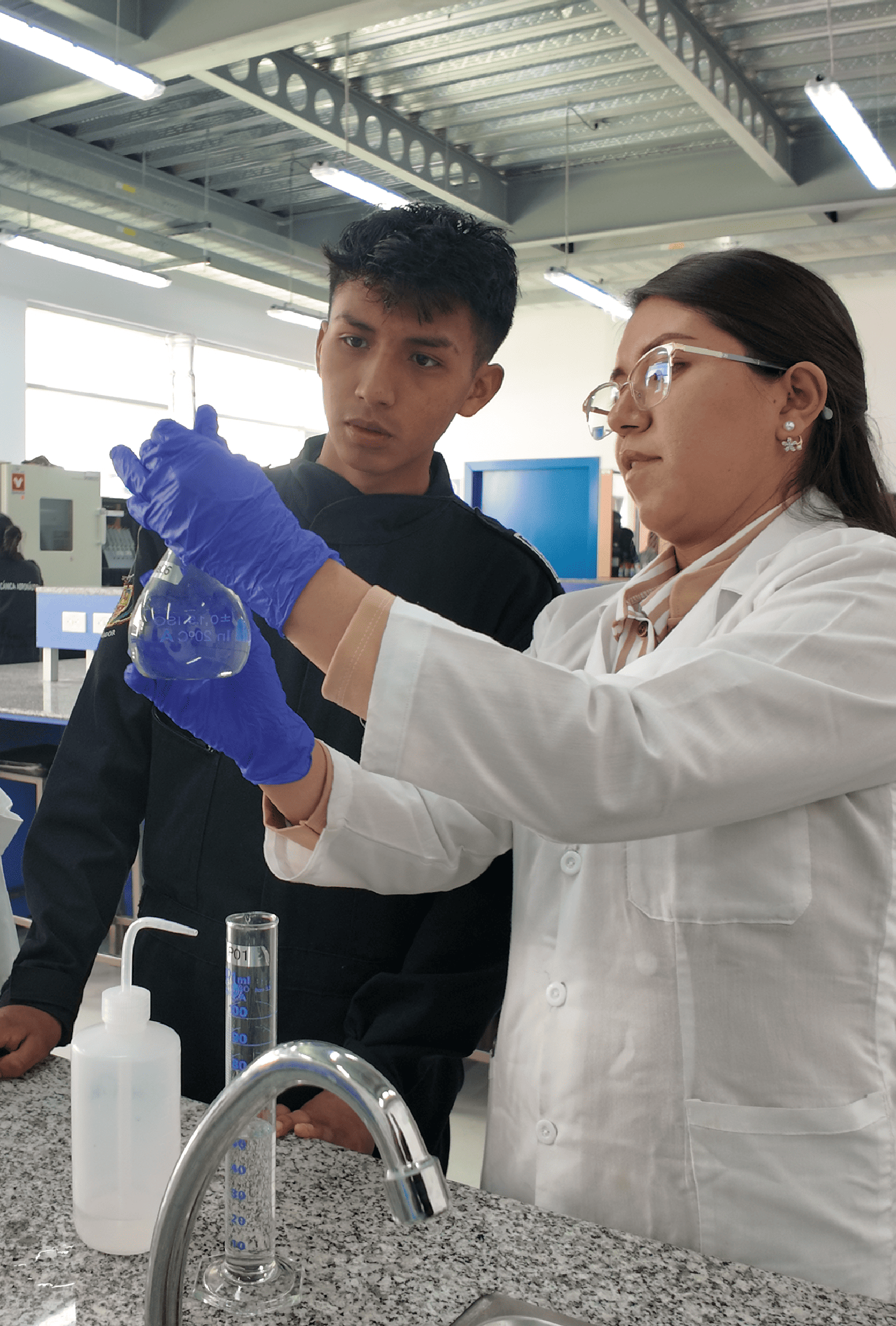
Design, development and execution of academic programs of undergraduate, graduate and continuing education higher education, integrating the substantive functions of teaching, research and liaison with society, in the following fields of knowledge: Computer Science; Energy and Mechanical Sciences; Earth Sciences and Construction; Economic, Administrative and Commercial Sciences; Space Sciences; Exact Sciences; Human and Social Sciences; Medical Sciences; Life Sciences and Agriculture; Electrical and Electronics; Security and Defence.
Institutional philosophy
1. Headquarters: Av. General Rumiñahui S/N and Calle Ambato, Sangolquí (Pichincha – Ecuador)
2. IASA Campus: Hacienda El Prado, IASA – Paylones S/N, Vía a Enkador, Sangolquí (Pichincha – Ecuador).
3. Latacunga Centro Campus: Calle Quijano y Ordóñez y Hermanas Páez, Latacunga (Cotopaxi – Ecuador).
4. Latacunga Belisario Quevedo Campus: Belisario Quevedo Parish, El Forastero neighborhood, Latacunga (Cotopaxi – Ecuador).
5. Santo Domingo Headquarters: Hacienda Zoila Luz, Vía Santo Domingo – Quevedo Km. 24, Santo Domingo (Santo Domingo de los Tsáchilas – Ecuador).
6. Language Institute: Av. 6 de Diciembre and Tomás de Berlanga, Quito (Pichincha – Ecuador).
Institutional philosophy
1. A sustained strengthening plan is implemented in the short and medium term, with clear priorities and strategic actions aligned with the National Development Plan 2025–2029, ensuring quality higher education, which contributes to the human, social and productive development of the country, with a focus based on equity and sustainability.
2. Support for Security and Defense in the country is strengthened, expanding and consolidating our undergraduate and graduate programs and prioritizing research projects in accordance with the 13 areas of knowledge and 47 lines of research of the Armed Forces’ R+D+i+P model and system.
3. The Strategic Studies Unit is consolidated as the direct advisory body to the command, so that its first-level technical analyses support decision-making at the political-strategic and strategic-military levels.
4. Anticipatory governance based on organizational culture and transformational leadership is promoted, with emphasis on ethics, transparency of processes, regulatory simplification and prospective planning, which leads us towards sustained institutional transformation.
5. Institutional actions are managed in a comprehensive and systematic manner to ensure high standards of quality over quantity in substantive processes, raising the results of national and international accreditation and certification, and the positioning of the University in rankings and external recognition mechanisms.
6. Priority is given to institutional orientation towards research, through participation in networks, congresses, mobility, training and other mechanisms, considering the particularities of the areas of knowledge and the interdisciplinary nature of science, which effectively impacts the increase of scientific production indicators and complies with the principles of academic ethics.
7. The substantive functions are articulated to effectively consolidate the link between academia and industry through programs and projects that promote innovation, entrepreneurship and other ways to promote R+D+i+P in the University, with emphasis on the management of exogenous funds.
8. The timely and systematic dissemination of the results of teaching, research, and links with society is guaranteed, in order to strengthen public visibility to increase the impact of academic activity and improve the institutional image and identity.
9. Knowledge without borders and insertion in global society are promoted through the learning of foreign languages by teachers and students, for the strengthening of substantive functions with international projection.
10. The comprehensive education of students is promoted through the development of scientific, cultural and sports activities, strengthening the processes of curricular research, academic mobility, clubs and spaces for student participation, consolidating institutional identity, the sense of belonging and university pride.
11. Management is oriented towards a Smart University that integrates emerging and disruptive technologies, anticipating needs, enhancing human talent and positioning the University at the forefront of the higher education system, in accordance with international standards and the demands of an increasingly digital and complex world.
12. The execution of comprehensive studies on entry, promotion, evaluation, workload and other processes that guarantee the stability and continuous development of the teaching career within the framework of the responsible use of institutional resources and the strengthening of the work environment is guaranteed.
13.The progressive and equitable improvement of the remuneration of academic and academic support staff is promoted, in accordance with current regulations and budgetary availability, to ensure excellence in the execution of substantive processes.
14. The physical and technological infrastructure is modernized, responding to the legitimate demands of teachers, researchers and students with well-equipped, calibrated and certified laboratories that allow the level of scientific production and dissemination to be raised. Progress is being made towards a green and sustainable campus that implements clean energy, optimizes the use of natural resources, fosters sustainable mobility, a culture of safety and promotes environmental education in academic programs and builds modern, efficient facilities that respect the environment and social welfare.
15. The University’s Institute of Postgraduate Education is created to enhance the fourth-level academic offer with emphasis on programs related to the domain of security and defense and international focus, optimizing design and implementation deadlines with a view to competitiveness and excellence.
16. The management of the University’s public company is consolidated by generating real value through dual projects of linkage and technology transfer, developing transparent and competitive processes that contribute to the strategic objectives of the University, the Armed Forces and society.
ESPE
We firmly believe that the internet should be available and accessible to anyone, and are committed to providing a website that is accessible to the widest possible audience, regardless of circumstance and ability.
To fulfill this, we aim to adhere as strictly as possible to the World Wide Web Consortium’s (W3C) Web Content Accessibility Guidelines 2.1 (WCAG 2.1) at the AA level. These guidelines explain how to make web content accessible to people with a wide array of disabilities. Complying with those guidelines helps us ensure that the website is accessible to all people: blind people, people with motor impairments, visual impairment, cognitive disabilities, and more.
This website utilizes various technologies that are meant to make it as accessible as possible at all times. We utilize an accessibility interface that allows persons with specific disabilities to adjust the website’s UI (user interface) and design it to their personal needs.
Additionally, the website utilizes an AI-based application that runs in the background and optimizes its accessibility level constantly. This application remediates the website’s HTML, adapts Its functionality and behavior for screen-readers used by the blind users, and for keyboard functions used by individuals with motor impairments.
If you’ve found a malfunction or have ideas for improvement, we’ll be happy to hear from you. You can reach out to the website’s operators by using the following email
Our website implements the ARIA attributes (Accessible Rich Internet Applications) technique, alongside various different behavioral changes, to ensure blind users visiting with screen-readers are able to read, comprehend, and enjoy the website’s functions. As soon as a user with a screen-reader enters your site, they immediately receive a prompt to enter the Screen-Reader Profile so they can browse and operate your site effectively. Here’s how our website covers some of the most important screen-reader requirements, alongside console screenshots of code examples:
Screen-reader optimization: we run a background process that learns the website’s components from top to bottom, to ensure ongoing compliance even when updating the website. In this process, we provide screen-readers with meaningful data using the ARIA set of attributes. For example, we provide accurate form labels; descriptions for actionable icons (social media icons, search icons, cart icons, etc.); validation guidance for form inputs; element roles such as buttons, menus, modal dialogues (popups), and others. Additionally, the background process scans all the website’s images and provides an accurate and meaningful image-object-recognition-based description as an ALT (alternate text) tag for images that are not described. It will also extract texts that are embedded within the image, using an OCR (optical character recognition) technology. To turn on screen-reader adjustments at any time, users need only to press the Alt+1 keyboard combination. Screen-reader users also get automatic announcements to turn the Screen-reader mode on as soon as they enter the website.
These adjustments are compatible with all popular screen readers, including JAWS and NVDA.
Keyboard navigation optimization: The background process also adjusts the website’s HTML, and adds various behaviors using JavaScript code to make the website operable by the keyboard. This includes the ability to navigate the website using the Tab and Shift+Tab keys, operate dropdowns with the arrow keys, close them with Esc, trigger buttons and links using the Enter key, navigate between radio and checkbox elements using the arrow keys, and fill them in with the Spacebar or Enter key.Additionally, keyboard users will find quick-navigation and content-skip menus, available at any time by clicking Alt+1, or as the first elements of the site while navigating with the keyboard. The background process also handles triggered popups by moving the keyboard focus towards them as soon as they appear, and not allow the focus drift outside it.
Users can also use shortcuts such as “M” (menus), “H” (headings), “F” (forms), “B” (buttons), and “G” (graphics) to jump to specific elements.
We aim to support the widest array of browsers and assistive technologies as possible, so our users can choose the best fitting tools for them, with as few limitations as possible. Therefore, we have worked very hard to be able to support all major systems that comprise over 95% of the user market share including Google Chrome, Mozilla Firefox, Apple Safari, Opera and Microsoft Edge, JAWS and NVDA (screen readers).
Despite our very best efforts to allow anybody to adjust the website to their needs. There may still be pages or sections that are not fully accessible, are in the process of becoming accessible, or are lacking an adequate technological solution to make them accessible. Still, we are continually improving our accessibility, adding, updating and improving its options and features, and developing and adopting new technologies. All this is meant to reach the optimal level of accessibility, following technological advancements. For any assistance, please reach out to